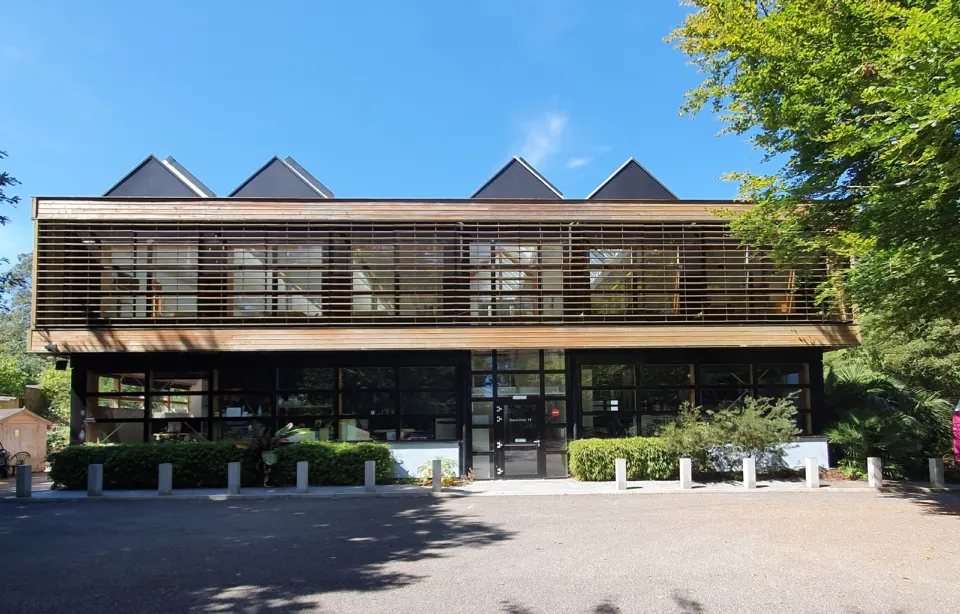
- Location
- Falmouth, Penryn
- Founded
- 1902 (university status 2012)
- Students
- about 8,200 (2024/25)
- Type
- Public university
- Main intakes
- September, January
- Study levels
- Undergraduate, Postgraduate, Research
Falmouth University is a specialist public university for the creative industries, based in the Cornish towns of Falmouth and Penryn. Founded as the Falmouth School of Art in 1902, it gained full university status in 2012. It enrols about 8,200 students across undergraduate, postgraduate and research degrees, most of them practice-based and taught in industry-style studios and workshops.
Why study at Falmouth University
Its strengths lie in art, design, media and performance subjects with a creative business strand, including well-established provision in illustration, photography, film, games, music and journalism. The university holds a Gold award in the Teaching Excellence Framework and shares its larger Penryn Campus with the University of Exeter. It suits applicants who want small-group studio teaching in a compact coastal community rather than a large city university.
Location and student life
Falmouth teaches across two campuses: the historic Falmouth Campus at Woodlane in the town centre, and the larger Penryn Campus nearby, which it shares with the University of Exeter. Both sit in Cornwall in the south-west of England, in and around the harbour town of Falmouth. Students typically live in university-managed or private housing in Falmouth, Penryn and nearby villages, including Glasney Student Village by the Penryn Campus. The area is compact and easy to get around, and the student community runs clubs, societies and events across both campuses.
Courses and subjects
Teaching is organised into nine departments: the Academy of Music & Theatre Arts, Cornwall Business School, the Fashion & Textiles Institute, the Games Academy, the Institute of Photography, the School of Architecture, Design & Interiors, the School of Art, the School of Communication, and the School of Film & Television. Well-established areas include fine art, illustration, photography, filmmaking, animation, games development, journalism and creative business. The university also offers integrated foundation years on some undergraduate degrees and online postgraduate degrees, so applicants who do not meet standard entry should check pathway options on the course pages.
Entry requirements for international students
International applicants are assessed on qualifications equivalent to UK entry requirements and, for most creative courses, a portfolio; exact requirements vary by course, so always check the relevant course page. The university publishes an undergraduate English minimum of IELTS (Academic) 6.0 overall with no band below 5.5. Postgraduate courses normally require a recognised first degree and may set higher English thresholds. Some undergraduate degrees offer an integrated foundation year, and pathway awards exist for students joining via partner institutions. Confirm the requirement for your course before applying.
Accommodation
The university offers university-managed accommodation, including Glasney Student Village near Penryn Campus alongside other halls and houses. Undergraduate international offer-holders who apply for accommodation on time are guaranteed a university-managed place, and dedicated international postgraduate rooms are available on a first-come, first-served basis. Many students later move into private rentals in Falmouth and Penryn. Apply early, and check deadlines, costs and contract lengths on the accommodation pages.
Scholarships and funding
The university publishes a set of international scholarships on its funding pages, and the awards change from year to year, so check the current list before applying. Recent examples include International Talent Scholarships of £2,500 for undergraduates, a Vice-Chancellor Scholarship of £10,000 for one first-year undergraduate, Postgraduate Country Awards of £3,000 for students from selected countries, and a Creativity in Everything Award of £2,000 for taught on-campus Masters courses. Some awards can be combined, and most apply only to on-campus study.