Apply for 2026 / 2027 intake.
Study at Royal Northern College of Music
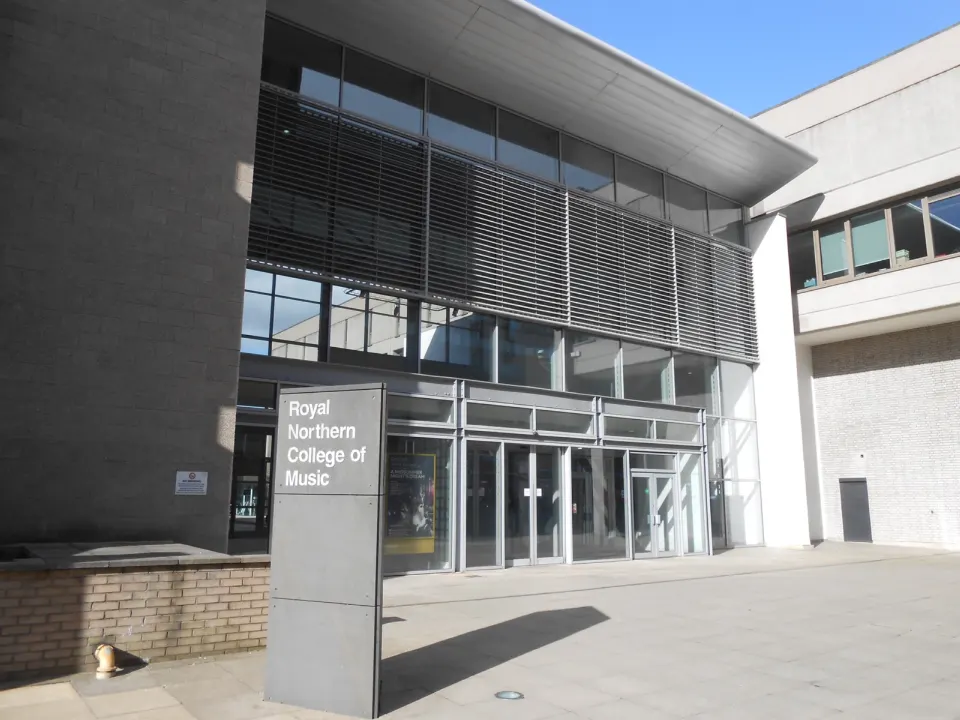
- Location
- Manchester
- Founded
- 1973 (merger of colleges founded 1893 and 1920)
- Students
- about 900-950, from more than 60 countries
- Type
- Public conservatoire
- Main intakes
- September
- Study levels
- Undergraduate, Postgraduate, Doctoral
The Royal Northern College of Music (RNCM) is a specialist music conservatoire in Manchester, formed in 1973 by the merger of the Royal Manchester College of Music (founded 1893) and the Northern School of Music (founded 1920). It teaches around 900-950 students from more than 60 countries, offering an intensive, performance-focused training where students learn from active musicians and perform regularly in the college's own concert hall, theatre and recital venues, which also host a large public programme.
Why study at Royal Northern College of Music
Degrees include the four-year BMus, postgraduate diplomas, the Master of Music and Master of Performance, and research degrees awarded in association with Manchester Metropolitan University; a joint course with the University of Manchester is also offered. The college is one of the four conservatoires associated with the Associated Board of the Royal Schools of Music and runs Junior RNCM, a Saturday school for talented young musicians aged 8 to 18.
Location and student life
The college occupies a single site at 124 Oxford Road, on the Oxford Road corridor south of Manchester city centre, an area the college describes as a busy and well-connected university quarter shared with the city's two large universities. Concert halls, practice facilities, the library and student services are all in one place, and the Sir Charles Groves Hall residence sits directly next door.
Manchester is a large student city with a long musical history, home to orchestras, live venues and festivals. Students can reach the shops, venues and stations of the city centre on foot or by the frequent buses along Oxford Road, and the college itself stages hundreds of public performances each year.
Courses and subjects
Teaching is organised into schools and departments including Strings, Keyboard Studies, Vocal Studies and Opera, Wind, Brass and Percussion, Composition, Conducting, Popular Music, Music Education, Academic Studies and Chamber Music, alongside a research department. Principal study options span orchestral instruments, piano, voice, opera, guitar, jazz, composition and popular music, with ensemble work, chamber music and professional placements built into the courses.
Undergraduate choices include the BMus, the BMus in Popular Music and a Graduate Diploma route; postgraduate options include the Master of Music, Master of Performance, Master of Education and advanced artist diplomas, plus doctoral study. There is no general non-music degree pathway: this is a conservatoire for musicians, with audition the central entry test, plus Junior RNCM for school-age players and a pre-sessional English course for offer holders.
Entry requirements for international students
Admission is by audition alongside academic qualifications, and applications are made through UCAS Conservatoires. International applicants whose first language is not English need an IELTS of 5.5 in each component for the four-year BMus and Master of Performance, 6.0 overall with no less than 5.5 in each component for the Master of Music (some options ask for 6.5 or 7.0), and 7.0 with 7.0 in writing for the PhD. A pre-sessional English course is available for offer holders just below the required level. Requirements vary by course, so check the exact English and qualification requirements for your programme before applying.
Accommodation
New students can choose to live in Sir Charles Groves Hall, a Unite Students residence directly next to the college with 612 rooms, mainly standard en-suite rooms in shared flats of four with a kitchen-lounge. For 2026/27 the cost is £221.07 per week on a 42-week contract covering term dates. Students who prefer private renting can look in nearby neighbourhoods and the city centre, including listings through Manchester Student Homes.
Scholarships and funding
The college provides over £3 million a year in scholarships and bursaries. Scholarships are awarded to applicants who show outstanding ability and potential at audition, and a limited number of RNCM Bursaries are available to international and postgraduate students on the basis of need and merit, deducted from tuition fees. Its international funding page also lists country-specific sources, such as awards for Australian and Canadian musicians. Scholarship names and values change each year, so check the latest funding information before you apply.
Take a look around Royal Northern College of Music
Official links and sources
- Royal Northern College of Music official website
- rncm.ac.uk/about
- rncm.ac.uk/study/courses
- rncm.ac.uk/study/apply/english-language-requirements
- rncm.ac.uk/study/apply/accommodation
- rncm.ac.uk/study/apply/fees-funding/international-student-funding
- rncm.ac.uk/study/apply/fees-funding/scholarships-bursaries
- en.wikipedia.org/wiki/Royal_Northern_College_of_Music