- Location
- London
- Founded
- 1826 (university status 2023)
- Students
- about 51,300 (2024/25)
- Type
- Public research university
- Main intakes
- September (selected research degrees also January)
- Study levels
- Undergraduate, Postgraduate taught, Postgraduate research
University College London (UCL) was founded in 1826 as London University, the first university institution established in London and the first in England to admit students regardless of their religion. Inspired by the ideas of Jeremy Bentham, it was secular from its foundation and admitted women to its faculties of Arts and Law and of Science in 1878.
Why study at University College London
Today UCL is a large public research university with about 51,300 students, around half of whom come from outside the UK. It is organised into 11 faculties covering arts and humanities, engineering, law, medicine and the life sciences, education and the built environment. UCL belongs to the Russell Group and the League of European Research Universities, and 33 Nobel Prizes have been awarded to its academics and alumni. Its historic Bloomsbury campus sits in central London, with a second major campus, UCL East, at the Queen Elizabeth Olympic Park in Stratford.
Location and student life
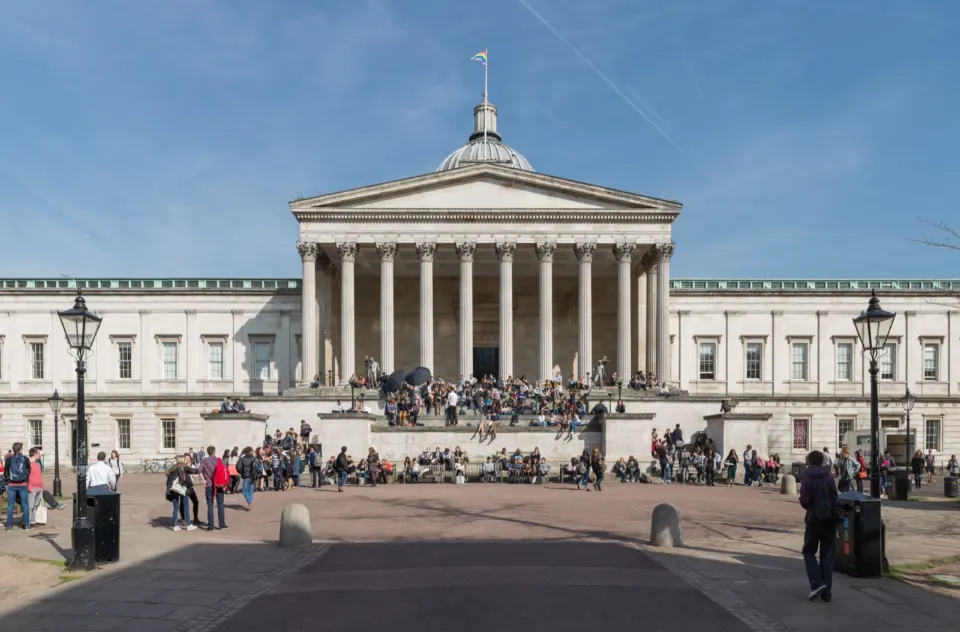
UCL's main campus is in Bloomsbury in central London, around its historic Wilkins Building on Gower Street, close to the British Museum, the West End and the mainline stations at Euston, St Pancras and King's Cross. In 2022 UCL opened UCL East, a second campus at the Queen Elizabeth Olympic Park in Stratford, east London, about 15 minutes' walk from Stratford station with its Underground, rail and international links. Students travel easily across the city by Tube and bus, and the Students' Union supports hundreds of clubs and societies alongside UCL's own museums, libraries and collections.
Courses and subjects
UCL is organised into 11 faculties: Arts and Humanities; the Bartlett (Built Environment); Brain Sciences; Engineering Sciences; the IOE (education and society); Laws; Life Sciences; Mathematical and Physical Sciences; Medical Sciences; Population Health Sciences; and Social and Historical Sciences. It is particularly noted for medicine and the life sciences, law, engineering, architecture and planning, and education. UCL offers more than 400 undergraduate and over 700 graduate programmes, alongside doctoral research across its departments, institutes and teaching hospitals. International students whose school qualifications are not accepted for direct entry can apply for the Undergraduate Preparatory Certificate (UPC), UCL's own one-year international foundation course taught on the Bloomsbury campus.
Entry requirements for international students
Entry requirements vary by course, so applicants should check the requirements on the relevant UCL course page before applying. For graduate study, UCL sets one of five English language levels per programme; the two most common require IELTS 6.5 overall with no less than 6.0 in each component, or 7.0 overall with no less than 6.5 in each component. Undergraduate programmes also set their own English and academic requirements by course. Students who narrowly miss the English requirement may be able to take a pre-sessional English course, and those whose school-leaving qualifications are not recognised can apply for the one-year Undergraduate Preparatory Certificate.
Accommodation
UCL guarantees an offer of accommodation in halls to all full-time first-year undergraduate students studying at UCL for the first time, provided they apply before the deadline and meet the eligibility criteria; the guarantee covers a place in halls rather than a specific room or price. First-year, full-time international postgraduate students are prioritised for places in halls under the same deadline conditions. UCL houses students in residences across London, including catered and self-catered options, with a limited number of affordable rooms for students from lower-income households.
Scholarships and funding
UCL offers the Global Undergraduate Scholarship for international students from lower-income backgrounds paying overseas fees: up to 33 awards are available for 2026/27, covering full tuition fees, with ten awards also including a maintenance allowance and a fixed allowance towards costs such as visas. For postgraduate study, the UCL Global Master's Scholarship provides £15,000 for one year to international students from lower-income backgrounds. Applicants can search the full range of awards on UCL's scholarships finder, as criteria, values and deadlines change each year.
Take a look around University College London
Official links and sources
- University College London official website
- en.wikipedia.org/wiki/University_College_London
- ucl.ac.uk/about/who-we-are/faculties-and-departments
- ucl.ac.uk/about/where
- ucl.ac.uk/study/clie/upc-foundation
- ucl.ac.uk/study/prospective-students/graduate/how-apply/english-language-requirements
- ucl.ac.uk/study/accommodation/how-apply-accommodation/how-apply-undergraduates
- ucl.ac.uk/scholarships/ucl-global-undergraduate-scholarship
- ucl.ac.uk/scholarships/ucl-global-masters-scholarship