- Location
- Birmingham
- Founded
- 1900 (royal charter; origins in 1825 and 1875)
- Students
- about 40,000 (25,530 undergraduate, 14,500 postgraduate, 2024/25)
- Type
- Public research university
- Main intakes
- September; January (selected postgraduate courses)
- Study levels
- Undergraduate, Postgraduate, Research, Foundation pathways
The University of Birmingham is a large public research university in the West Midlands, founded by royal charter in 1900 from the earlier Queen's College and Mason Science College. As the first English civic university to gain its own charter, it is known as a red-brick university and is a founding member of the Russell Group and the Universitas 21 network. Its staff and alumni include Nobel laureates, and it teaches around 40,000 students, with 2024/25 figures making it one of the largest student populations in the UK.
Why study at University of Birmingham
The university is organised into five colleges covering arts and law, engineering and physical sciences, life and environmental sciences, medicine and health, and social sciences. It has noted strengths in medicine, business, law and the sciences, with teaching linked to nearby hospitals and a triple-crown accredited business school. International students form a large part of the community, with more than 10,000 students from over 150 countries.
Location and student life
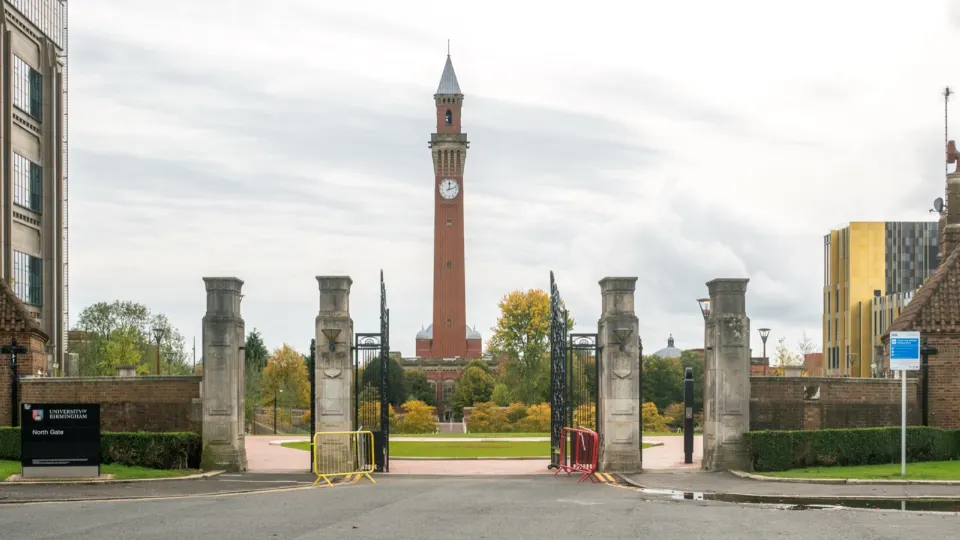
The main Edgbaston campus lies south-west of Birmingham city centre, with historic red-brick buildings around Chancellor's Court and the Joseph Chamberlain clock tower alongside modern teaching and laboratory blocks. A second nearby site at Selly Oak hosts further student facilities, and the university also runs a campus in Dubai. The Edgbaston campus has its own railway station with trains to Birmingham New Street in a few minutes, plus frequent buses into the city. Students have access to the Guild of Students, sports facilities and a large, mixed student district nearby.
Courses and subjects
Teaching is spread across five colleges: Arts and Law (including Birmingham Law School and English, Drama and Creative Studies), Engineering and Physical Sciences, Life and Environmental Sciences (including Biosciences and Geography, Earth and Environmental Sciences), Medicine and Health (including Birmingham Medical School), and Social Sciences (including Birmingham Business School, Education, Government and Social Policy). Medicine, dentistry, business, law and engineering are among its best-known areas. International applicants who do not meet direct entry grades can apply for foundation pathways delivered on campus through the Birmingham International Academy.
Entry requirements for international students
International applicants apply with their country's school-leaving qualifications or an international foundation year, plus proof of English. Typical English thresholds published by the university sit around IELTS 6.0 overall for many undergraduate courses and 6.5 overall for many postgraduate courses, with higher requirements in areas such as law and healthcare. The Birmingham International Academy runs presessional English courses and one-year foundation pathways for students who need extra preparation. Exact grades and scores vary by course, so check the individual course page before applying.
Accommodation
The university guarantees new international students a room in its accommodation if they apply by the published deadline (31 July for new international undergraduates). Options include self-catered and catered halls across its villages at Edgbaston and Selby Oak areas, such as the Vale, plus rooms with trusted partner providers. Students apply online once they hold an offer, and accommodation pages list prices, contract lengths and what is included.
Scholarships and funding
The university lists several international awards on its scholarships pages. Examples include the Postgraduate High Fliers Scholarship of £5,000 for international masters students, undergraduate High Fliers awards of £5,000 for students from selected regions, and an Arts and Humanities International Scholarship of £3,000 for international undergraduates. Larger country-specific awards, such as Future Skills Scholarships for Indian masters students, are advertised in some years. Amounts and eligibility change each year, so check the current scholarships database before applying.
Take a look around University of Birmingham
Official links and sources
- University of Birmingham official website
- en.wikipedia.org/wiki/University_of_Birmingham
- birmingham.ac.uk/about/colleges-schools-and-departments
- birmingham.ac.uk/study/accommodation/apply-for-your-accommodation/guarantee-scheme
- birmingham.ac.uk/study/accommodation/apply-for-your-accommodation/international-students
- birmingham.ac.uk/study/international/bia/presessional-english/entry-requirements-for-presessional-english
- birmingham.ac.uk/study/international/bia/foundation-pathways-bia
- birmingham.ac.uk/study/scholarships-funding/postgraduate-high-fliers-scholarship
- birmingham.ac.uk/study/scholarships-funding/college-of-arts-and-law-scholarships