- Location
- Bristol
- Founded
- 1909 (royal charter; University College, Bristol 1876)
- Students
- about 32,400 (2024/25)
- Type
- Public research university
- Main intakes
- September
- Study levels
- Undergraduate, Postgraduate, Research
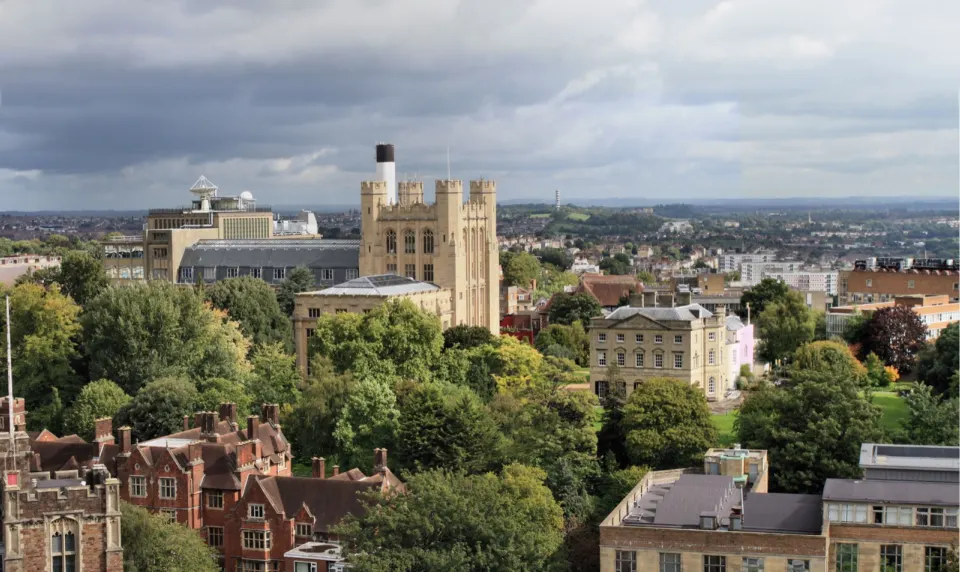
The University of Bristol is a public research university in Bristol, England. Its royal charter dates from 1909. Before that it was University College, Bristol (1876), and its medical school goes back further still, to 1833. Bristol belongs to the Russell Group of research-intensive universities and teaches around 32,400 students across three faculties. It counts as a red-brick university and also belongs to the Europe-wide Coimbra Group and the Worldwide Universities Network.
Why study at University of Bristol
Research is Bristol's calling card. In the most recent Research Excellence Framework assessment it ranked fifth in the UK for research quality, with leading places for chemistry, physics, engineering, mathematical sciences, computer science and earth sciences. Nobel laureates feature among its staff and graduates. Subjects it is noted for range across medicine, engineering, the sciences, economics, management, politics and law.
Location and student life
The Clifton Campus sits in the middle of Bristol, and the university describes it as truly part of the city. The Wills Memorial Building, its best-known landmark, stands on Park Street. From there it's a short walk down to the harbourside and the city centre. Bristol is a harbourside city in south-west England, and the university calls it a walkable city, where much of student life happens on foot.
The university has also developed a second major site in the centre of Bristol, the Temple Quarter Enterprise Campus, for business, digital and innovation subjects. Some Business School teaching moves there from 2026. Further afield, the Mumbai Enterprise Campus is its international campus in India.
Courses and subjects
Three faculties organise the teaching. Arts, Law and Social Sciences covers the Business School, the Law School, education, economics, humanities, modern languages, sociology, politics and social policy. Health and Life Sciences covers medicine, dentistry, veterinary science, biological and biomedical sciences, and psychology and neuroscience. Science and Engineering covers chemistry, physics, mathematics, computer science, earth and geographical sciences, and several engineering schools.
If you don't yet meet direct entry requirements as an international student, the university runs a one-year, full-time International Foundation Programme. University academics teach it, and it leads on to undergraduate degrees.
Entry requirements for international students
What you need varies by course, so read the exact terms on the course page you're interested in. Academic requirements depend on the education system you've studied in, and English requirements are set through language profiles attached to each course. As a rough guide, the undergraduate-level thresholds the university refers to sit around IELTS 6.5 overall, while some postgraduate and professional courses ask for more. If you narrowly miss the English requirement, you can take a pre-sessional English course before your degree begins.
Accommodation
The university publishes an accommodation guarantee. It covers first-year undergraduates, first-year postgraduates paying international fees, International Foundation Programme students and others. To qualify, you must firmly accept your study offer, apply for accommodation by the guarantee deadline (30 June for September entry) and meet the other conditions, which include studying full time and arriving unaccompanied. The university can promise you a room, but not a room in a particular residence you've asked for. If you're outside the guarantee, you can still apply, and you may get a place if space remains.
Scholarships and funding
For international students, the main funding route is the Think Big scholarship scheme. In recent entry rounds the university invested up to £5 million in it, with undergraduate awards of £6,500 or £13,000 per year towards tuition fees, and postgraduate awards of £3,000, £6,500, £13,000 or £26,000 towards tuition fees in the first year. GREAT Scholarships of £13,000, run with the British Council, are open to one-year postgraduate students from India, Malaysia and the USA. Awards, values and deadlines change each year, so check the university's scholarships pages for the current round.
Take a look around University of Bristol
Official links and sources
- University of Bristol official website
- bristol.ac.uk/faculties
- bristol.ac.uk/international/fees-finance/scholarships
- bristol.ac.uk/accommodation/apply/guarantee
- bristol.ac.uk/academic-language/study/ifp
- bristol.ac.uk/academic-language/study/pre-sessional/entry-requirements
- bristol.ac.uk/city/bristols-culture/a-walkable-city
- en.wikipedia.org/wiki/University_of_Bristol