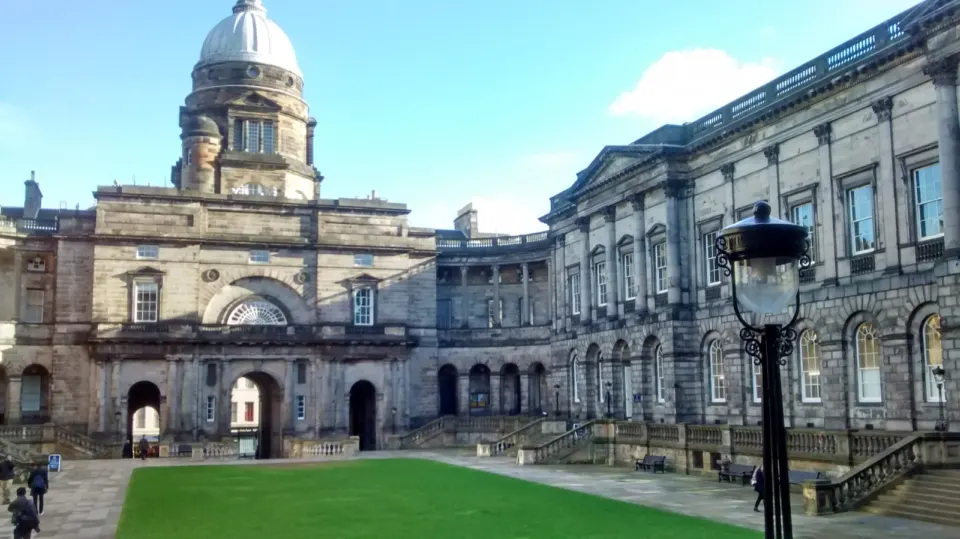
- Location
- Edinburgh
- Founded
- 1583 (royal charter 1582; opened 1583)
- Students
- 39,015 (2024/25)
- Type
- Public university
- Main intakes
- September; January (selected postgraduate routes)
- Study levels
- Undergraduate, Postgraduate, Research
The University of Edinburgh is a public research university in Scotland's capital. Founded in 1583, it is one of Scotland's four ancient universities. In 2024/25 it enrolled about 39,015 students. Academically it is organised into three colleges (Arts, Humanities and Social Sciences; Medicine and Veterinary Medicine; and Science and Engineering) with 25 schools in total.
Why study at University of Edinburgh
You can study almost any major subject here, from medicine, veterinary medicine and the biological sciences to informatics, engineering, law, business and economics, plus the creative disciplines at Edinburgh College of Art. Teaching and research cover all of these areas. For international students whose school qualifications don't allow direct entry, the university runs a one-year International Foundation Programme. Much of the university sits in the city centre, beside the historic Old Town, and the historic Old College is among its best-known buildings.
Location and student life
Unlike a single-campus university, Edinburgh teaches across several sites in and around the city. The Central Area covers the historic Old Town and Southside, around George Square and Old College, about 15 minutes' walk from Waverley station. Science and engineering are concentrated at King's Buildings in the south, linked to the centre by a university shuttle bus. Veterinary teaching is based at Easter Bush, and medicine also uses sites at the BioQuarter and Western General. Edinburgh airport is about 12km from the city centre, around 30 minutes away by bus or tram. Student life centres on the compact city centre: university clubs, societies and sport sit alongside union venues such as Teviot Row House, and many students live in Pollock Halls and other university accommodation nearby.
Courses and subjects
Teaching sits in three colleges made up of 25 schools. Arts, Humanities and Social Sciences includes the Business School, the School of Law, the School of Economics, Edinburgh College of Art, and Moray House School of Education and Sport, along with schools for history, literature, languages, philosophy, psychology and social science. Medicine and Veterinary Medicine brings together Edinburgh Medical School and the Royal (Dick) School of Veterinary Studies. Science and Engineering covers biological sciences, chemistry, informatics, mathematics, physics and geosciences. If your qualifications don't allow direct entry as an international applicant, you can apply for the one-year International Foundation Programme, taught on campus. It prepares you for undergraduate degrees across the colleges.
Entry requirements for international students
Requirements vary by course and by country, and the university publishes guidance for each country, so check the page that covers your qualifications and your degree. Many undergraduate degrees ask for IELTS Academic 6.5 overall with at least 5.5 in each component. Postgraduate programmes commonly ask for 6.5 to 7.0 overall, depending on the subject, and other tests, TOEFL iBT for example, are accepted at stated grades. If you narrowly miss the English requirement, pre-sessional English is available. If your school-leaving qualifications aren't accepted for direct entry, consider the International Foundation Programme. Either way, confirm the exact grades on the course page before you apply.
Accommodation
The university guarantees an offer of accommodation to all eligible undergraduate students from outside Edinburgh, as long as they meet the criteria and apply by the published deadline. You can choose between places such as Pollock Halls, near the central campuses, and other university-managed halls and flats, in catered or self-catered form. Pollock Halls sit at the foot of Arthur's Seat, close to both the Central Area and King's Buildings. Prices, contract lengths and the full guarantee criteria are on the accommodation pages.
Scholarships and funding
Several named awards are open to international students, though funding changes each year, so check the scholarships pages for current eligibility and deadlines. The Edinburgh Global Undergraduate Mathematics Scholarships, for example, are worth £5,000, paid in instalments towards living costs, for outstanding international applicants to mathematics degrees. Edinburgh Global Online Distance Learning Masters Scholarships deduct fixed sums such as £5,000 from tuition fees on eligible part-time programmes. The university's scholarship search will help you find awards that fit your level and subject.
Take a look around University of Edinburgh
Official links and sources
- University of Edinburgh official website
- ed.ac.uk/schools-departments/colleges-schools
- study.ed.ac.uk/undergraduate/entry-requirements/english-language
- study.ed.ac.uk/undergraduate/student-life/accommodation
- registryservices.ed.ac.uk/student-funding/undergraduate/international/mathematics
- vet.ed.ac.uk/education/postgraduate/taught/animal-welfare
- cahss.ed.ac.uk/international-and-study-abroad/foundation-programme
- ed.ac.uk/visit/city/getting-here
- en.wikipedia.org/wiki/University_of_Edinburgh