- Location
- London
- Founded
- 1836 (Royal Charter)
- Type
- Public federal research university
- Students
- about 205,400 on campus plus about 37,400 by distance learning (2021–22)
- Structure
- 17 self-governing member institutions plus central academic bodies
- Study levels
- Undergraduate, Postgraduate, Research
The University of London is a federal public research university established by Royal Charter in 1836. It brings together 17 self-governing member institutions, including University College London, King's College London, the London School of Economics and Political Science, Birkbeck, Goldsmiths and City St George's, with central bodies such as the School of Advanced Study. Most students apply to, and are taught by, a member institution, while the central university also awards University of London Worldwide degrees studied by distance and flexible learning.
Why study at University of London
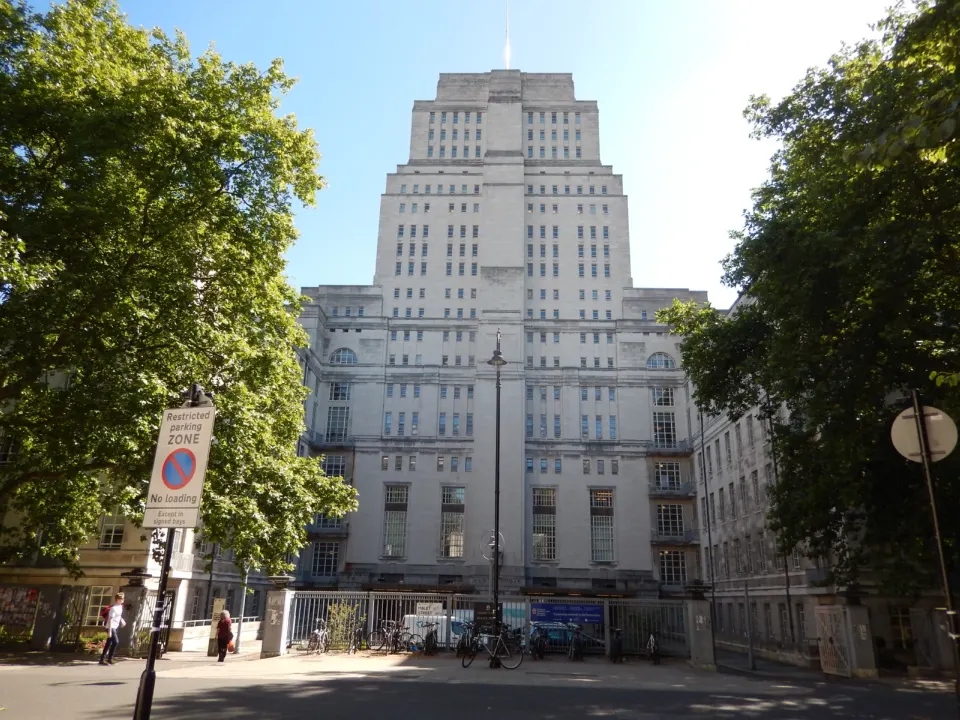
It is one of the largest student bodies in the UK, with about 205,400 campus-based students and about 37,400 distance learners in 2021-22, and more than 50,000 distance learners in recent years. Its central base is Senate House in Bloomsbury, home to a large humanities and social sciences library. Recognised areas include law, business, computer science, medicine and the humanities, with distance-learning provision tracing its history to 1858.
Location and student life
The university's central buildings stand in Bloomsbury in central London, around Senate House on Malet Street, close to the British Museum, the British Library and Russell Square. King's Cross St Pancras, Euston and Russell Square stations give direct Underground, rail and Eurostar connections, and several member campuses lie within walking distance of each other. Students use Senate House Library and shared study spaces at BLOOM @ Senate House, alongside the libraries and unions of their own colleges. Bloomsbury offers museums, parks, cinemas and relatively quiet streets by central London standards.
Courses and subjects
Teaching is spread across the federation, so subjects follow the member institutions: economics, finance and social sciences with LSE direction, law, business administration, computer science, data science and psychology by flexible study, clinical trials and public health with the London School of Hygiene & Tropical Medicine, and humanities research through the School of Advanced Study institutes. There is also a University of London Institute in Paris. The central university lists undergraduate and postgraduate distance degrees, short courses and International Foundation Programmes for students preparing for degree-level study.
Entry requirements for international students
For University of London Worldwide distance and flexible programmes, applicants normally need secondary or prior qualifications accepted as equivalent to UK entry standards, plus evidence of English. The published guidance accepts IELTS overall 6.0 with at least 5.5 in each sub-test for some programmes, with higher scores for others. Foundation programmes and other preparatory routes are available for students who do not yet meet direct entry. Requirements vary by course and by member institution for on-campus study, so check the exact course page before applying.
Accommodation
The central university runs inter-collegiate halls of residence in Bloomsbury and across central London, housing more than 3,000 students from across the federation. Halls commonly include catered and self-catered rooms with shared facilities, alongside the University of London Housing Services, which helps students find private rooms, flats and houses. Places in halls are limited and allocated by application, so early application is advised. Member institutions also provide their own accommodation guidance for students studying on their campuses.
Scholarships and funding
The university publishes centrally administered awards on its scholarships and bursaries pages, and the list changes each year. Verified examples include the Yusuf Ali Scholarships of £5,000 for women in India and Pakistan, the Mary Stiasny Scholarship offering full undergraduate funding beginning with students in Pakistan, and Laws bursaries including 30% for LLB alumni and 40% for LLM applicants resident in Pakistan, Bangladesh, Malaysia or Sri Lanka. Check eligibility, deadlines and the current list on the official scholarships pages, as awards change each year.
Take a look around University of London
Official links and sources
- University of London official website
- en.wikipedia.org/wiki/University_of_London
- london.ac.uk/federation
- london.ac.uk/study/how-apply/entry-requirements
- london.ac.uk/study/foundation-programmes
- london.ac.uk/federation/student-benefits
- london.ac.uk/study/fees-funding/funding-study/scholarships-bursaries/yusuf-ali-scholarships-women-india-pakistan
- london.ac.uk/study/fees-funding/funding-study/scholarships-bursaries/llm-scholarships-bursaries