- Location
- Oxford
- Founded
- c. 1096 (teaching evidenced)
- Students
- about 26,800 (2025)
- Type
- Collegiate research university
- Colleges
- 36 colleges plus halls and societies
- Main intakes
- October
- Study levels
- Undergraduate, Postgraduate taught, Postgraduate research
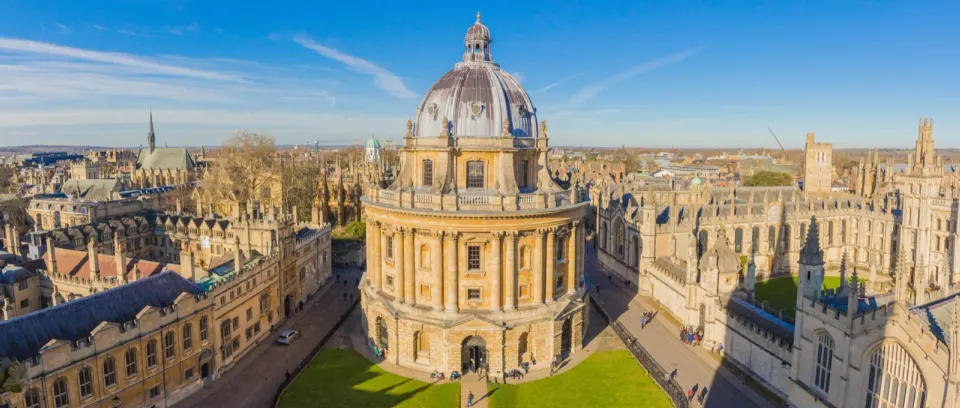
The University of Oxford is a collegiate research university in Oxford, England, with evidence of teaching as early as 1096, making it the oldest university in the English-speaking world and the second-oldest university in continuous operation. It comprises more than thirty self-governing colleges and halls alongside academic departments organised into four divisions, and teaches around 26,800 students. Undergraduate teaching centres on the tutorial system, in which one to four students meet an academic each week to discuss an essay or problem sheet, supported by lectures, seminars and laboratory work. Oxford is known for academic strength across the humanities, social sciences, sciences and medicine, and is regularly placed among the leading universities worldwide, including within the top five in the Times Higher Education World University Rankings. College communities give students a close academic and social home within a large research university.
Location and student life
The university's colleges, departments and facilities are spread across the compact centre of Oxford, a cathedral city and the county town of Oxfordshire in England. Most students live, study and socialise within walking or cycling distance of their college, which provides accommodation, dining, library and social spaces. Oxford station has direct trains to London Paddington and a frequent coach service also links the city with London, so travel to and from the capital is straightforward. Terms are short and intensive, with teaching concentrated in three eight-week terms across the academic year, leaving vacations for essays, revision and travel.
Courses and subjects
Academic work is organised into four divisions: Humanities; Social Sciences; Mathematical, Physical and Life Sciences; and Medical Sciences. Between them they cover Oxford's undergraduate and graduate courses, from classics, philosophy and law to engineering, computer science, biology and mathematics. All undergraduate courses include the weekly tutorial alongside lectures, seminars and practical work. Oxford offers no international foundation pathway: its Astrophoria foundation years are for UK state-school students only, so international applicants apply directly for degree entry. Graduate study includes taught master's degrees and research doctorates (DPhil) across all four divisions.
Entry requirements for international students
International students apply directly for Oxford's undergraduate and graduate courses, as the university's foundation years are not open to international applicants. Undergraduate selection includes interviews with academic staff, held online. Applicants whose first language is not English must meet the university's English-language requirements for their course. Graduate applicants apply for a specific master's or DPhil course by its December or January deadline. Exact academic and English requirements vary by course, so check the official course pages and the university's admissions guidance before applying.
Accommodation
All colleges provide rooms for first-year undergraduates, usually on the main college site or a short walk away. Several colleges also accommodate undergraduates for every year of their course. Rooms are typically single study bedrooms, many with an en-suite bathroom. The university cannot guarantee accommodation for graduate students, though most first-year graduates secure a college or university room. Check your college's accommodation pages for prices, deadlines and options.
Scholarships and funding
Oxford's main centrally-administered awards include the Clarendon scholarships for new master's and DPhil students, which cover course fees in full plus a living-costs grant (at least £20,780 in 2025–26), with applicants automatically considered, and Reach Oxford awards for undergraduates. Most graduate awards use the December or January course application deadline, so early preparation matters. Eligibility, values and deadlines change each year, so check the university's official fees and funding pages for current details.